Step into any electronics store, and the wall of televisions can make even a simple purchase feel confusing. Screen sizes range from modest 43-inch models to massive 85-inch displays. The real difference comes down to making the right choice, since a wrong one has little to do with price and everything to do with a few practical details shoppers often overlook.
Getting the size of the Samsung Smart TV right affects picture quality, comfort, and how a room feels once the television is installed. Luckily, figuring out the right size comes down to a few scalable factors, not assumptions. A clear understanding makes this decision much easier, whether the television is going into a compact bedroom or a spacious open-plan living area.
What Actually Determines the Right Screen Size
Screen-size decisions boil down to a simple relationship between distance and resolution, plus personal preference and lighting. Knowing a couple of main principles can remove much of the guesswork, which is why two identical televisions can look entirely different in different room types.
So, here’s what really determines the size decision:
- Considering viewing distance more than the screen size alone
- Sitting too close makes pixels visibly larger on screens
- Sitting far can waste resolution even in smaller screens
- Store lighting and displays can change real-world perception
- Resolution changes how close you can sit comfortably
Once you consider distance and resolution, the picture becomes clearer. A higher-resolution smart TV that runs 4K content can be comfortably viewed from a shorter distance than an older 1080p set. This means most households can enjoy a larger screen in the same room than previous size guidance would suggest.
Key Factors That Shape the Right Choice
Here are a couple of factors that are important to consider when deciding on the right screen size for any specific room:
Room Size and Viewing Distance
One of the most reliable starting points for selecting the right screen size is its viewing distance. It directly relates to display size. Getting this measurement done accurately can prevent most common sizing mistakes before people bring their television home.
Here’s a typical distance-based by room-type of which screen size works best:
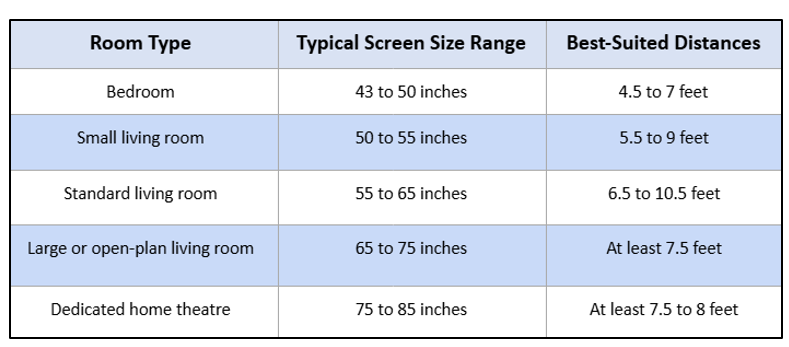
Accurately measuring your seating distance against these ranges can quickly help you choose the size that looks right in your space.
Screen Resolution and Picture Technology
Resolution determines exactly how close a viewer can sit before any individual pixel becomes visible. This directly affects which screen size works well in smaller rooms. Higher-resolution panels support visibly larger screens at shorter viewing distances than older displays could match.
Impact of resolution with minimum distance:
- 1080p needs about 1.6 times the screen height
- 4K needs about 0.8 times the screen height
- 8K needs about 0.4 times the screen height
- On a 55-inch screen, that’s roughly 7 feet for 1080p
That’s exactly why most living rooms today work in favor of 4 K, as it delivers visibly sharper picture quality across daily viewing distances.
How the Household Actually Watches
Viewing habits matter as much as the room’s dimensions. They’re mostly overlooked during the buying process. Daily habits of a household and not just the room size determine the shape to which screen size makes sense.
A few viewing habits worth considering:
- Sports and fast-moving content benefit from larger screens
- Bright rooms need higher peak brightness to avoid washout
- Multiple viewers benefit from wider viewing angles
- Gaming setups often prioritize low input lag over size
A couple of these habits often override the basic distance-and-resolution equation. However, they help fine-tune the final size decision.
Wall Space and Mounting Options
Where and how a television is mounted can also limit practical sizes, regardless of what the room allows technically. Existing furniture, wall studs, and power outlets directly influence the final buying decision.
Mounting factors that affect your options:
- Spatial limits for wall stud mount placement
- Fireplace walls that limit the actual height
- Furniture-based stands capping the actual screen width
- Cable routing impacting where power reaches
It’s always smart to check every detail before you buy a Smart TV, rather than buying a screen that barely fits on the wall.
Budget and Long-Term Value
Price differences among screen sizes aren’t constant. Buying more expensive furniture for your bedroom doesn’t always result in better choices. By comparing cost per inch, we can find the real value.
How to think about your budget realistically:
- Small and medium sizes offer real value
- Enormous displays have a perceptible size premium
- Space of lesser size that has hardly any use in case of premier sizes
- Consider future viewing needs in advance
Investing or paying for more only makes sense when that extra feature or size aligns with the space in which you’ll use it.
Final Thoughts
Choosing the right TV size depends more on how you’ll use it in a space than on what looks impressive under store lights. A showroom is a place designed to make displays look more prominent and sharper than they will at home. It is for this reason that measurements are more important than the first impression
Whether it is Samsung Smart TVs that have sprung up in various sizes on the market, anyone comparing options will find that the same principles of distance, resolution and viewing behavior apply whenever you are looking at similar products, irrespective of the brand. So, making a measured, informed choice is always easier and more reliable than guessing.