The surge in aging populations has exponentially increased the global demand for medical-grade oxygen. Historically, respiratory therapy relied heavily on cumbersome, high-pressure oxygen cylinders. These massive steel tanks severely limited patient mobility and fundamentally restricted their daily independence.
Today, the healthcare industry is undergoing a profound paradigm shift toward Portable Oxygen Concentrators (POCs). This transition from heavy, pressurized vessels to wearable technology represents a triumph of modern biomedical engineering.
It seamlessly merges advanced materials science with modern healthcare innovation to deliver life-saving therapies across the globe. By prioritizing user autonomy, engineers are redesigning respiratory care from the ground up, demanding devices that are both clinically robust and ergonomically discreet.
The Evolution of Point-of-Care Oxygen Generation
Modern oxygen generation relies on a fascinating scientific principle known as medical Pressure Swing Adsorption (PSA). Instead of storing finite amounts of pre-pressurized oxygen, these sophisticated medical devices act as dynamic, real-time chemical filters.
They continuously draw in and process ambient room air, which naturally consists of roughly 78% nitrogen, 21% oxygen, and 1% trace atmospheric gases. Through a highly orchestrated mechanical cycle, an internal micro-compressor pressurizes this ambient air and forces it into specialized cylindrical canisters.
These canisters are densely packed with highly engineered crystalline beds designed to selectively trap nitrogen molecules. As the nitrogen binds to the material, the purified oxygen is allowed to flow unimpeded directly to the patient’s delivery cannula.
The Heart of the Machine: Advanced Adsorption Media
The monumental downsizing of oxygen concentrators from hospital-scale units to lightweight, wearable devices hinges entirely on the chemical efficiency of the internal adsorption material. According to supply chain and technical data from leading Jalon, integrating these advanced zeolite beds allows medical device manufacturers to drastically reduce the compressor size and overall weight of portable concentrators while reliably maintaining a 93% (±3%) oxygen purity level.
High-performance lithium-based media absorb nitrogen much faster and in far greater volumes per gram than older, traditional materials. This leap in chemical efficiency is the absolute foundation of modern respiratory device miniaturization.
Without these advanced micro-materials, achieving a continuous flow of high-purity oxygen in a sub-5-pound device would be physically impossible. The materials dictate the machine’s entire operational footprint.
Why Lithium-Based Molecular Sieves are Game Changers
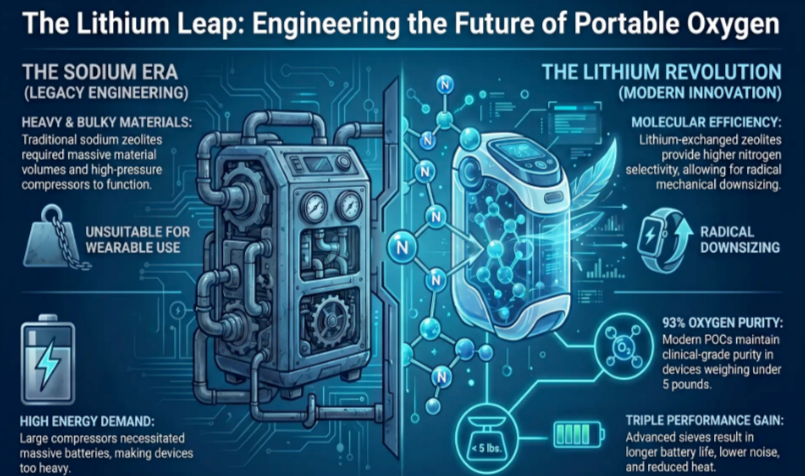
The true, beating core of any medical PSA system is its molecular sieve material. For several decades, industry manufacturers relied almost exclusively on traditional sodium-based zeolites. These older materials were undeniably effective, but they required massive volumes to achieve clinical-grade oxygen outputs consistently.
Because these sodium zeolites necessitated significantly more surface area to trap sufficient nitrogen, engineers were forced to integrate heavy, high-pressure compressors. These larger compressors, in turn, demanded massive lithium-ion batteries to sustain operation, severely bottlenecking the miniaturization process.
Lithium-exchanged zeolites have completely revolutionized this restrictive engineering dynamic in recent years. By chemically substituting standard sodium ions with highly active lithium ions, the crystalline framework gains an extraordinarily high nitrogen selectivity.
This specific molecular structure interacts profoundly with the natural quadrupole moment of atmospheric nitrogen molecules. Consequently, the kinetic adsorption rate accelerates dramatically within the sieve bed.
Medical device engineers can now achieve the exact same clinical gas separation efficiency using a fraction of the original material volume. This fundamental shift in applied materials science is the singular innovation that enables true, wearable portability for respiratory patients.
Balancing Portability with Continuous Output
Shrinking a life-supporting respiratory device into a compact, shoulder-slung package introduces immense, multifaceted engineering hurdles. A portable concentrator must constantly generate highly purified oxygen without rapidly exhausting its power supply or overheating its internal components.
Achieving this delicate equilibrium requires uncompromising precision in both mechanical and chemical design. The integration of highly efficient lithium-based adsorbents directly addresses and mitigates these interconnected operational bottlenecks.
Because the advanced sieve material requires significantly less pneumatic pressure to trap nitrogen effectively, internal mechanics can be radically downsized. This efficiency yields several critical design advantages for the end user:
- Weight reduction: Smaller sieve beds and miniature compressors eliminate pounds of excess mechanical mass, allowing the creation of truly ambulatory, ultra-lightweight wearable units.
- Battery life: By drastically decreasing the mechanical load and resistance on the compressor, the device draws significantly less electrical power, maximizing continuous ambulatory operation.
- Noise reduction: A smaller compressor operating at lower atmospheric pressures inherently generates far less acoustic vibration and mechanical hum, maintaining clinical stealth in public spaces.
- Heat dissipation: Less mechanical friction and a lower overall power consumption profile drastically reduce internal ambient temperatures, preventing long-term component degradation.
Integrating these streamlined mechanical systems into the broader chronic disease management digital ecosystem further enhances their clinical efficacy. Real-time Bluetooth data tracking allows for proactive and predictive maintenance protocols. This ensures the miniaturized compressor and precision sieve beds consistently operate at peak safety performance.
Meeting Stringent Global Medical Standards
Despite the rapid industry push for extreme miniaturization, clinical efficacy and patient safety can never be compromised for the sake of convenience. Portable oxygen concentrators are strictly classified as critical, life-supporting medical devices by international regulatory bodies.
To legally enter the global market, these devices must reliably and continuously output oxygen purities of 93% (±3%) under all operational circumstances. Biomedical engineers must rigorously and continuously test these portable systems to ensure they maintain this precise purity across highly diverse environmental challenges.
These delicate devices must perform flawlessly at high mountainous altitudes, in extreme tropical humidity, and during severe ambient temperature fluctuations. Any sudden drop in oxygen purity could quickly trigger severe hypoxemia in vulnerable patients relying on continuous flow therapy.
Ensuring a consistent and reliable flow of medical-grade oxygen is not merely an engineering goal; it is a strict regulatory necessity. Devices utilizing advanced PSA technologies must meet rigorous global standards to ensure patient safety across varying environmental conditions.
As comprehensively outlined in the essential medicine guidelines by the World Health Organization (WHO), oxygen systems and concentrators must consistently deliver highly purified oxygen to be certified for life-supporting respiratory therapies in both clinical and homecare settings.
Key Takeaways
| Area | Key Takeaway | Impact/Data |
| Core Material | Adopt Li-zeolites | Enables sub-5-lb POCs |
| Mechanics | Downsize compressors | Extends battery life |
| Compliance | Meet WHO guidelines | Secures 93% (±3%) purity |
| Patient UX | Lower internal pressure | Cuts noise and heat |
Conclusion
The rapid evolution of portable medical oxygen systems serves as a profound testament to the unseen, life-saving power of micro-materials. While intuitive digital interfaces and sleek, modern exterior designs often capture the immediate attention of the consumer market, the true breakthrough lies hidden.
It resides deep within the microscopic, engineered pores of advanced lithium zeolites. By mathematically and chemically perfecting nitrogen separation at the molecular level, engineering teams have accomplished much more than merely optimizing a medical machine.
They have fundamentally restored the gift of mobility, personal independence, and basic life dignity to millions of people actively managing severe respiratory conditions worldwide. Materials science, in this context, is not just engineering—it is the breath of life.