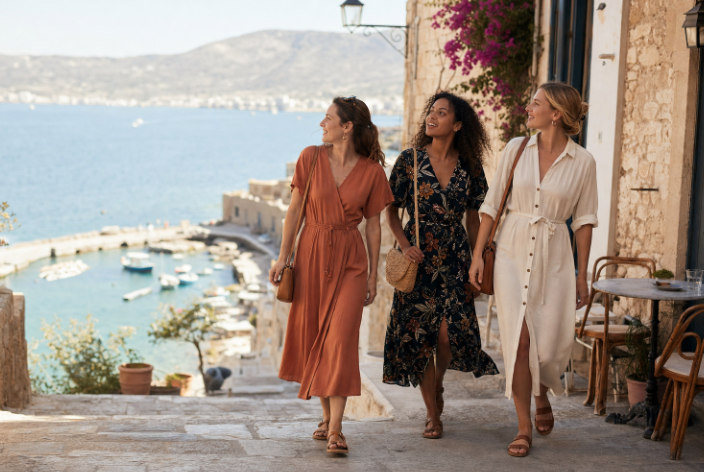
Somewhere between travel planning and social media inspiration, vacation dressing became a form of destination cosplay. A weekend in Paris seemed to require an entirely new minimalist wardrobe. A Mediterranean escape called for white linen, oversized hats, and a basket bag. A tropical itinerary produced another familiar uniform of dramatic prints and flowing resortwear.
These outfits may create attractive photographs, but they often have little to do with how travel actually feels. Real vacations involve uneven streets, changing temperatures, crowded transportation, unexpected rain, long lunches, museum rules, and far more walking than anticipated.
The result is a strangely modern problem: travelers pack clothes that look perfect for the imagined destination but fail during the actual trip. An outfit may coordinate beautifully with a hotel balcony while being completely unsuitable for the train station, local market, or ten-minute uphill walk required to reach that balcony.
A better vacation wardrobe does not turn its wearer into a character. It helps her remain herself in a different place.
The Destination-Cosplay Trap
Travel content often presents destinations through recognizable visual codes. Santorini is reduced to blue and white. Paris becomes neutral tailoring. A tropical resort means saturated prints and woven accessories. These codes make locations immediately identifiable online, but they can flatten both personal style and the complexity of the destination.
The problem is not wearing linen near the sea or enjoying a romantic floral print in a historic town. The problem begins when every clothing choice is made for the background rather than the experience.
Destination cosplay encourages travelers to ask, “What would look right in this photograph?” A functional wardrobe begins with different questions: What will I be doing? How will the temperature change? How far will I walk? Which social settings might appear unexpectedly?
The answers usually lead to clothing that feels less theatrical and more personal. Instead of imitating a travel fantasy, the wearer creates a flexible visual language that can adapt to the place.
Vacation Dresses Should Pass the 10,000-Step Test
A dress is one of the most efficient items to pack because it creates a complete outfit without requiring multiple separates. Yet not every attractive dress is genuinely travel-friendly.
When selecting vacation dresses for women, apply the 10,000-step test. Imagine wearing the dress through an entire day rather than for a single photograph. Could you walk through a museum, sit at a café, climb a staircase, enter a place of worship, and continue directly to dinner?
The most useful styles have secure necklines, breathable fabrics, and silhouettes that allow natural movement. Midi lengths are especially adaptable because they offer coverage without creating the difficulties of a floor-length hem. Short sleeves, adjustable waists, and practical pockets can also make a meaningful difference.
Footwear is part of the test. If a dress only works with shoes that cannot survive several hours of walking, it is less versatile than it appears. A strong vacation dress should look equally intentional with flat sandals, simple sneakers, or low evening shoes.
The goal is not to make every outfit purely functional. It is to choose clothes whose beauty continues after the first kilometer.
Dress for Transitions, Not Isolated Activities
Travel itineraries rarely unfold in perfectly separated stages. A morning walk becomes an afternoon museum visit. Lunch lasts longer than expected. A return to the hotel is abandoned when someone suggests drinks near the harbor.
Clothing designed for only one moment creates unnecessary logistical pressure. The traveler either carries a change of clothes, returns to the hotel repeatedly, or spends part of the day feeling incorrectly dressed.
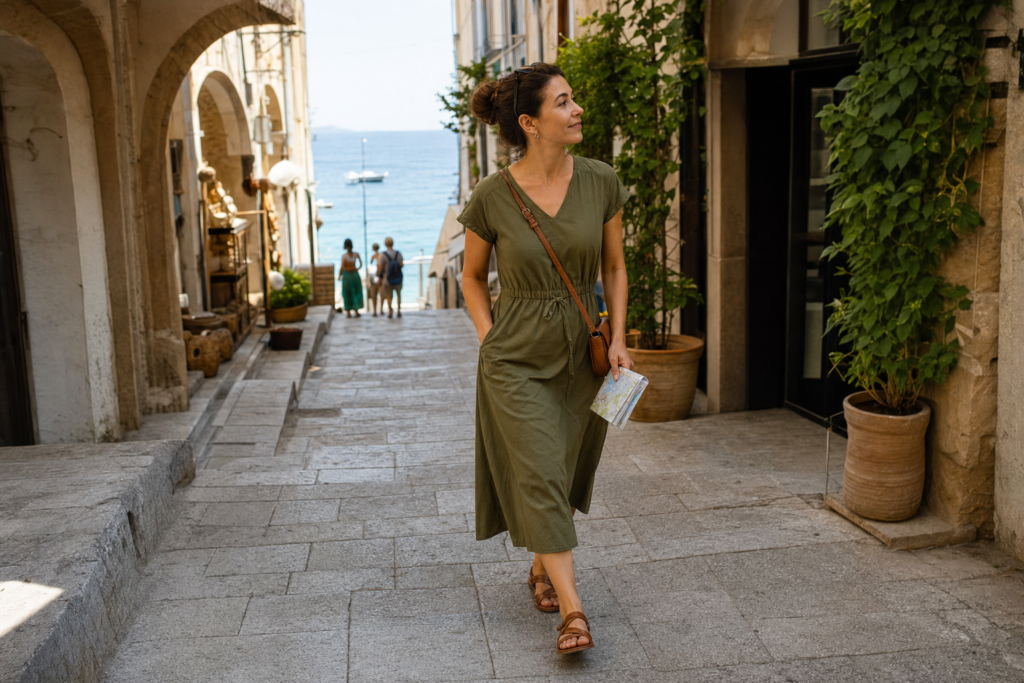
Transitional dressing solves this by treating the day as one continuous experience. A fluid midi dress may work with a crossbody bag and flat sandals in the morning, then shift toward dinner with earrings and a smaller bag. A lightweight shirt dress can be worn open over swimwear before becoming a complete outfit for lunch.
The best travel clothes absorb changes in atmosphere without requiring a complete transformation. They make spontaneity easier because the wearer does not need to protect an outfit from real life.
Florals Can Reference a Place Without Imitating It
Floral clothing is especially vulnerable to destination clichés. Tropical flowers are often treated as mandatory for island vacations, while delicate botanical prints are repeatedly associated with European gardens.
A sophisticated flower womens dress does not need to reproduce the local scenery. It can create a subtler dialogue with the destination through color, scale, and movement.
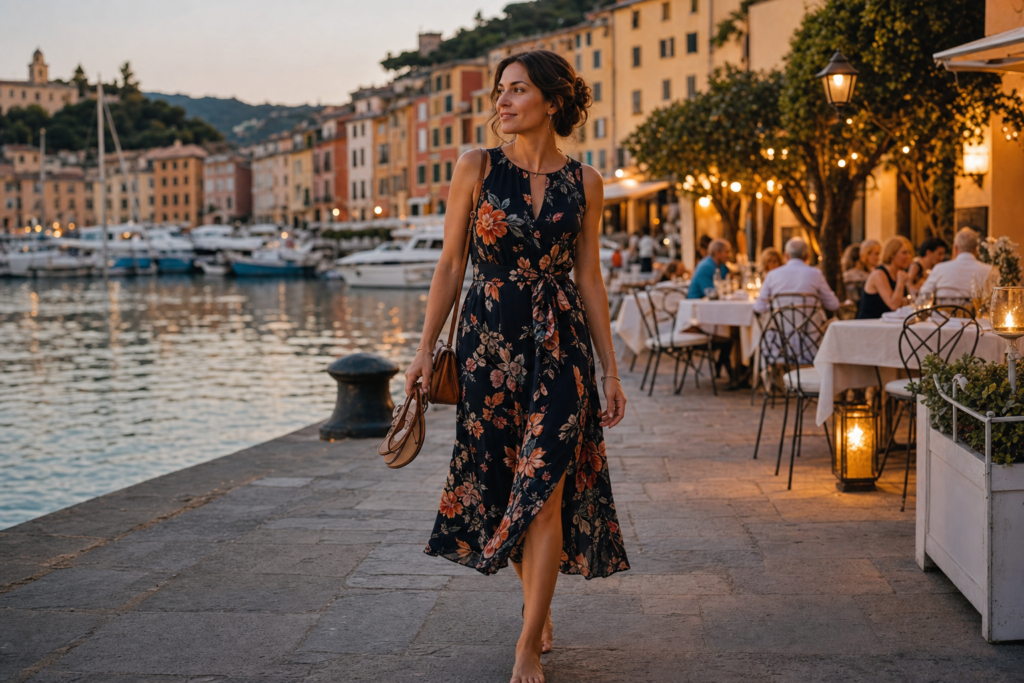
Dark-background florals work beautifully for trips that extend from daytime exploration into evening dining. They provide visual interest in sunlight but gain depth under warm restaurant lighting. Painterly flowers feel more individual than literal souvenir-style prints, while muted botanical motifs can complement historic architecture without appearing costume-like.
The print should remain the main visual element. Flat sandals, a compact shoulder bag, and minimal jewelry allow it to carry the outfit. When every accessory repeats the vacation theme, the result can feel more like styling for a campaign than dressing for a real journey.
Pack a Personal Palette, Not a Destination Palette
Travel advice often recommends packing within a limited color palette, and the principle is useful. The mistake is assuming that palette must imitate the destination.
Someone who never wears beige at home is unlikely to feel authentic in an entirely neutral vacation wardrobe. A traveler who prefers darker colors does not need to abandon them simply because the location is sunny. Personal style should travel too.
Choose three or four colors already present in your wardrobe, then adjust their materials and weight for the climate. Deep green can feel summery in linen or lightweight cotton. Burgundy becomes suitable for warm weather in a fluid sleeveless silhouette. Navy can replace black when a softer contrast is desired.
A personal palette also makes packing easier. Shoes, layers, and bags can work across multiple outfits without producing a suitcase full of identical looks. Repetition becomes coherence rather than limitation.
The Three-Destination Rule
Before packing any dress, test it against three possible destinations within the trip.
Could it work at a café? Could it enter a cultural or religious site with the addition of a light layer? Could it continue to an evening restaurant without looking overly casual?
A piece does not need to serve every possible situation, but it should succeed in at least three realistic contexts. This rule quickly exposes garments chosen primarily for photographs.
The dramatic white maxi dress that only works beside the hotel pool may not earn its suitcase space. A floral midi that works for sightseeing, lunch, and dinner probably does. A relaxed mini dress may cover the beach, a casual market, and an evening walk when styled with different accessories.
Versatility does not make clothing boring. It asks each garment to participate in more of the journey.
Leave Space for the Place Itself
Overplanned outfits can create a subtle distance between a traveler and her surroundings. When every moment is evaluated as potential content, attention shifts away from the location and toward maintaining an image.
Clothing should support curiosity, not compete with it. A secure bag makes it easier to explore a market. Comfortable shoes allow an unplanned walk. A breathable dress makes sitting outside for another hour feel possible. These practical details influence the quality of the trip more than a perfectly coordinated photograph.
There is also a cultural benefit to dressing with restraint. Destinations are not sets constructed for visitors. Local communities have their own rhythms, customs, and expectations. Clothing that is adaptable and appropriately covered allows travelers to move through more spaces respectfully.
The most compelling travel style often looks as though it belongs to the wearer rather than to the location. It acknowledges the climate and context without turning the culture into an accessory.
See also: How F&B License Singapore Requirements Have Evolved for Modern Food Businesses
A Better Vacation Photograph
The irony is that clothes designed for real travel often produce better photographs. When an outfit allows movement, people stand more naturally. When shoes are comfortable, they walk instead of posing. When a neckline stays secure and a skirt moves easily, attention can remain on the experience.
The resulting images may be less staged, but they contain more information: wind in the fabric, the changing light, the expression that appears during an actual conversation, and the imperfect energy of a day in motion.
A successful vacation wardrobe should not announce the destination before the background does. It should reveal something about the person wearing it—her preferences, her confidence, and the way she chooses to experience a place.
The next time you pack, resist the urge to invent a temporary travel identity. Bring dresses that can walk, adapt, and collect memories. A destination may inspire what you wear, but it should never require you to become someone else.