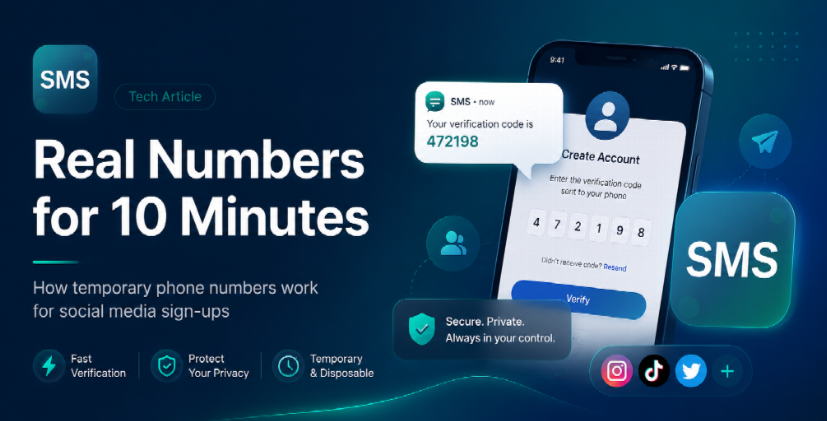
Creating a new social media account usually takes only a few minutes. You enter an email address, choose a password, add some basic information, and you are ready to go.
But there is one step that can make the process less convenient: phone verification.
Platforms may ask users to enter a mobile number and confirm it with a one-time SMS code. This helps services reduce automated registrations, protect accounts, and confirm that a real user is behind the sign-up attempt.
The problem is that not everyone wants to connect their personal mobile number to every new online account.
This is one reason temporary and short-term phone numbers have become increasingly popular. Instead of using a primary SIM card, a user can receive a verification SMS through another number that is available for a limited period of time.
Why Social Media Platforms Ask for Phone Numbers
Phone verification is now common across many online services.
Social networks, messaging applications, marketplaces, email providers, fintech platforms, and other websites may request a phone number when a user:
- creates a new account;
- signs in from a new device;
- enables additional security features;
- recovers access to an account;
- performs an action considered unusual by the platform.
The phone number is usually followed by an SMS containing a short verification code.
From the platform’s perspective, this creates an additional layer between automated activity and legitimate users. From the user’s perspective, however, it also means sharing another piece of personal information with an online service.
For people who prefer to keep their main mobile number private, a separate verification number can be useful.
What Is a Temporary Phone Number?
A temporary phone number is a number that is available to a user for a limited purpose or period rather than being permanently attached to their primary mobile subscription.
There are several different types of numbers available online, and they should not all be treated as identical.
Some services provide shared public numbers where incoming messages can potentially be visible to multiple visitors. These are usually unsuitable for accounts containing personal information.
Other platforms provide numbers individually for a specific SMS activation.
There are also longer-term rental numbers that can remain available for days or weeks when continued access to the same number is important.
The appropriate option depends on what the user needs.
What Does a “Real Number for 10 Minutes” Mean?
The phrase can sound unusual because a phone number normally stays active for months or years.
In this context, however, the time limit usually describes how long the user has access to the number, not necessarily how long the underlying number itself has existed.
A 10 minute phone number can be used when someone needs enough time to request a verification message, receive the SMS, and enter the code on the website or application.
A typical process looks like this:
- The user selects the required service or platform.
- A country or available number is selected.
- The number is entered during account registration.
- The platform sends an SMS verification code.
- The incoming code appears in the activation interface.
- The user enters the code and completes verification.
For a straightforward registration, this process may take only a few minutes.
The important distinction is that short-term access does not automatically mean a number is suitable for every website. Individual platforms have their own verification rules and may accept or reject particular number types.
Temporary Numbers vs. Your Personal Number
Using a personal SIM card is still the simplest option in many cases, particularly for an important account that may require future recovery.
There are nevertheless situations where keeping the personal number separate makes sense.
For example, someone may be testing a new application, separating work activity from personal communication, managing different online identities for legitimate projects, or simply trying to reduce how widely their primary number is distributed.
Temporary numbers provide another option for those situations.
They are especially practical when the number is required only once to receive an initial verification message.
Temporary Does Not Always Mean VoIP
One common source of confusion is the difference between temporary access and the technical type of a number.
A temporary number can refer to how long the customer can use it. VoIP, mobile, landline, and other classifications refer to how a number operates within telecommunications infrastructure.
These concepts are not interchangeable.
This matters because some online platforms apply different verification rules depending on the type, country, operator, or previous history of a phone number.
As a result, there is no universal number that is guaranteed to work with every social network.
How SMS Activation Services Work
An SMS activation platform acts as an intermediary between the user and a pool of available phone numbers.
Rather than purchasing another physical SIM card simply to receive one message, a user selects the required service and obtains access to a number through an online interface.
The user then requests the OTP or verification message from the social platform.
Once the message arrives, the verification code is displayed online.
Services such as SMS Activate platforms are designed around this short verification workflow, allowing users to select numbers for supported services and countries without maintaining an additional physical SIM for every registration.
Availability can vary significantly by platform and region. A country that works reliably for one application may not necessarily be the best option for another.
When a Longer Rental Is Better
A ten-minute activation is useful only when access to the number is genuinely short-term.
There are situations where keeping the same number is more important.
For example, a platform might request another SMS several days later after a login from a different device. The user may also want the phone number available as part of an account recovery process.
In such cases, a longer rental or permanent SIM is a better choice.
This is particularly important for valuable social media accounts.
If an account represents a business, contains important contacts, manages advertising, or has a significant audience, relying exclusively on a number that cannot be accessed again may create unnecessary recovery problems.
What If the Verification SMS Does Not Arrive?
SMS verification does not always work immediately.
Several factors can affect delivery:
- the selected operator;
- the number’s country;
- temporary carrier delays;
- restrictions imposed by the social platform;
- repeated verification requests;
- previous use of the number;
- incorrect country codes;
- service-specific filtering.
Repeatedly requesting a new SMS every few seconds is usually not helpful and may cause the platform to impose temporary restrictions.
It is generally better to check that the number was entered correctly, wait briefly, and then try another available option if necessary.
Privacy Is Only Part of the Equation
Temporary numbers are often discussed primarily as privacy tools, but convenience is just as important.
Keeping a personal number away from unnecessary registrations can reduce the number of services connected to a primary identity and makes it easier to separate different types of online activity.
At the same time, users should consider what happens after registration.
If the social media account will still be important six months later, there should be another reliable recovery method available, such as an email address, authenticator application, backup codes, or a phone number that remains under the user’s control.
A temporary number solves the immediate SMS verification problem. It should not automatically be treated as a permanent account recovery strategy.
Follow the Platform’s Rules
Temporary phone numbers are simply a telecommunications and verification tool. How they can be used depends on the rules of the individual website or application.
Users should always follow the terms of service of the social platform they are registering for.
A separate number can help protect privacy or keep personal and professional activity separated, but it should not be used to impersonate others, evade platform restrictions, create abusive accounts, or conduct fraudulent activity.
Final Thoughts
Phone verification has become a normal part of creating accounts online, particularly on social media and other platforms that need to control automated registrations.
Using a personal mobile number is not the only option.
Short-term numbers can provide enough time to receive a verification code without permanently connecting a primary SIM card to another online service. Depending on the situation, users can choose between a brief SMS activation, a longer number rental, or a traditional mobile number they control permanently.
The most important factor is matching the type of number to the purpose of the account.
For a simple one-time verification, a number available for several minutes may be enough. For an important account that may require future SMS verification, longer-term access is usually the safer and more practical choice.