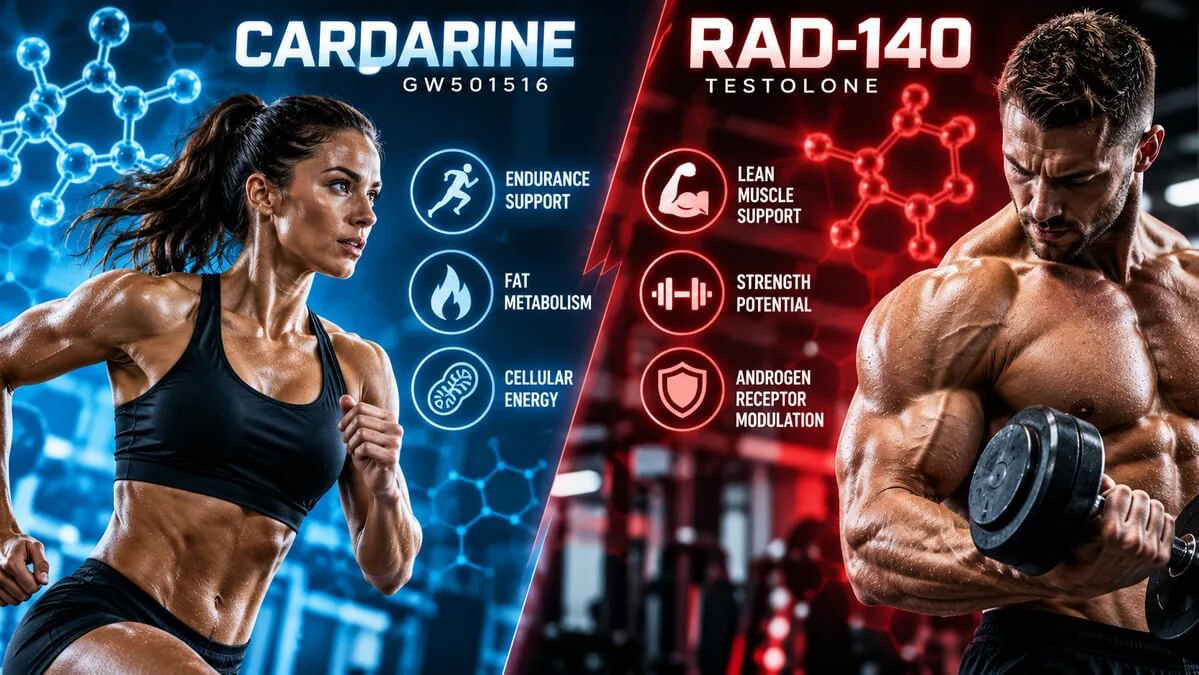
Cardarine and RAD-140 are two names that frequently appear within the same discussions surrounding experimental performance-related compounds.
That can create the impression that the two substances are closely related.
Scientifically, however, they are remarkably different.
RAD-140, also known as Testolone, is an investigational selective androgen receptor modulator (SARM). Cardarine, or GW501516, is not a SARM at all. It is a PPARδ agonist that has been investigated primarily for its effects on metabolic pathways.
The distinction matters because understanding what a research compound actually does is far more informative than simply grouping substances together according to how they are discussed online.
So how do Cardarine and RAD-140 differ, and what does the published research actually tell us about them?
What Is Cardarine?
Cardarine is the commonly used name for GW501516, an experimental compound originally investigated for its potential effects on metabolism.
It acts as an agonist of peroxisome proliferator-activated receptor delta, normally abbreviated to PPARδ.
PPARs are nuclear receptors involved in regulating the expression of genes associated with several important metabolic processes.
PPARδ in particular has attracted scientific interest because of its involvement in areas including fatty-acid metabolism, glucose utilisation and energy homeostasis.
This mechanism explains why researchers became interested in GW501516.
It also explains why calling Cardarine a SARM is scientifically incorrect.
Cardarine Is Not a SARM
The term SARM stands for selective androgen receptor modulator.
To fall within that category, a compound must interact with the androgen receptor in the appropriate way.
GW501516 does not exert its principal effects through androgen-receptor modulation.
Instead, its primary research mechanism involves activation of PPARδ.
Nevertheless, Cardarine is frequently sold, discussed and categorised alongside SARMs such as Ostarine, LGD-4033 and RAD-140.
This appears largely to be a consequence of the communities in which these compounds became popular rather than their underlying pharmacology.
Researchers seeking further information about Cardarine UK, including compound specifications and analytical information, can find additional details through Affordable Nutrition.
Why Did Researchers Become Interested in PPARδ?
PPARδ plays a role in the regulation of energy metabolism.
Preclinical research has investigated how activation of this receptor can influence processes involving fatty-acid oxidation and energy utilisation.
Some of the best-known animal research involving GW501516 examined metabolic adaptations associated with endurance.
This research contributed significantly to the attention surrounding the compound.
However, animal research needs to be interpreted carefully.
An effect observed under controlled experimental conditions in an animal model does not automatically establish the same outcome in humans.
Animal studies are extremely useful for understanding mechanisms and identifying areas worthy of further investigation, but they are not substitutes for controlled human evidence.
What Is RAD-140?
RAD-140, commonly known as Testolone, belongs to a completely different research category.
It is an investigational selective androgen receptor modulator.
Where Cardarine primarily concerns PPARδ signalling, RAD-140 was developed to interact selectively with androgen receptors.
Androgen receptors are found in tissues throughout the body and are involved in numerous physiological processes.
The scientific objective behind SARM development has been to investigate whether compounds can produce useful androgen-receptor activity with a different tissue-response profile from conventional steroidal androgens.
RAD-140 emerged from this area of research.
What Does Selective Androgen Receptor Modulation Mean?
Traditional androgens can activate androgen receptors across numerous tissues.
Researchers developing SARMs have investigated whether non-steroidal molecules could produce more selective patterns of activity.
This is the origin of the word “selective” in selective androgen receptor modulator.
It is important, however, not to interpret selective as meaning that a compound affects only one tissue.
Nor does selectivity mean that a substance is automatically free from unwanted effects.
RAD-140 remains an experimental compound, and its biological activity needs to be considered in that context.
Researchers looking for further product information and supporting analytical documentation for RAD-140 for sale in the UK can find additional details through Affordable Nutrition.
Cardarine Versus RAD-140: The Fundamental Difference
The clearest way of understanding the difference between these compounds is to compare their primary biological targets.
Cardarine / GW501516:
Primarily associated with PPARδ activation and metabolic signalling.
RAD-140 / Testolone:
Primarily associated with selective androgen-receptor modulation.
This means the compounds begin from entirely different pharmacological starting points.
The fact that both are frequently discussed within fitness and research-compound communities does not make their mechanisms similar.
Why Are They So Frequently Discussed Together?
Online classification does not always follow pharmacological classification.
Experimental compounds are frequently grouped according to the audiences interested in them rather than their actual mechanisms.
Consequently, compounds as different as MK-677, Cardarine and genuine SARMs can all appear under the same broad category.
MK-677 is a growth hormone secretagogue.
Cardarine is a PPARδ agonist.
RAD-140 is a selective androgen receptor modulator.
Those are three fundamentally different mechanisms.
Understanding this distinction helps prevent marketing terminology from being mistaken for scientific classification.
What Does the Research Say About RAD-140?
Much of the early published research surrounding RAD-140 has been preclinical.
Laboratory and animal studies investigated its androgen-receptor activity and tissue selectivity.
RAD-140 has subsequently entered human clinical research under the name vosilasarm, including investigation in patients with androgen-receptor-positive breast cancer.
This progression into human clinical research is important because it allows researchers to collect information that cannot be established from animal models alone.
However, clinical investigation should not be confused with general regulatory approval.
A compound entering human trials remains investigational while researchers assess questions surrounding biological activity, safety and potential therapeutic applications.
What Does the Research Say About Cardarine?
GW501516 also attracted substantial scientific interest, particularly in relation to metabolism.
Early human research examined metabolic markers including lipid profiles.
However, the compound’s development history also contains an important safety issue.
Preclinical toxicology studies produced serious concerns, including increased tumour development in certain animal models.
These findings contributed to GW501516 not progressing into an approved medicine.
It would be scientifically incorrect to state that an animal toxicology result proves an identical outcome will occur in humans.
It would be equally inappropriate to ignore such findings.
Preclinical toxicology exists specifically to identify potential safety signals that may be relevant to subsequent human development.
Why Evidence Type Matters
One of the biggest problems when researching experimental compounds online is that very different forms of evidence can be presented as though they carry equal weight.
They do not.
A laboratory experiment can help researchers understand a biological mechanism.
An animal study can provide information about biological activity and potential safety signals in a living organism.
A controlled human trial provides information directly involving people under defined research conditions.
An anecdotal report provides an individual’s experience but cannot reliably establish cause and effect.
Each type of evidence can contribute information, but conclusions should reflect the limitations of the evidence being considered.
Compound Verification Matters Too
Research is only meaningful if researchers know what substance they are actually studying.
This is particularly relevant to experimental compounds sold online.
Published investigations of products marketed as SARMs have previously identified discrepancies between product labels and laboratory analysis, including products containing different quantities or different compounds from those advertised.
Independent analytical testing can therefore provide valuable information concerning compound identity and purity.
A certificate of analysis should not be interpreted as evidence that a research compound is safe or effective.
Its purpose is different: it provides analytical information about what a sample contains.
Experimental Does Not Mean Approved
Another important distinction concerns terminology.
A compound having published research behind it does not necessarily mean it is an approved medicine.
Drug development typically involves extensive laboratory work, preclinical research and multiple stages of human clinical investigation before regulators can consider whether a medicine has demonstrated an acceptable balance of benefits and risks for a particular medical indication.
Neither Cardarine nor RAD-140 should therefore be treated as conventional nutritional supplements simply because they are frequently discussed within the fitness industry.
Their scientific status is considerably different.
Two Compounds, Two Different Areas of Research
Cardarine and RAD-140 provide a useful illustration of why experimental compounds should be understood according to their pharmacology.
Cardarine is associated principally with PPARδ activation and metabolic signalling.
RAD-140 is associated with selective androgen-receptor modulation.
Their mechanisms, research histories and evidence bases are consequently very different.
Both have generated considerable scientific and public interest, but grouping them together without recognising these differences can produce a misleading picture.
For anyone examining the research, the most useful approach is therefore to look beyond category labels and ask three fundamental questions:
What biological target does the compound interact with?
What type of evidence supports the claims surrounding it?
And what limitations or safety findings exist within that evidence?
Those questions provide a much stronger foundation for understanding Cardarine, RAD-140 and experimental research compounds generally.
This article is provided for general educational and research information only. GW501516/Cardarine and RAD-140 are investigational compounds and this article should not be interpreted as medical advice or as recommending their use.