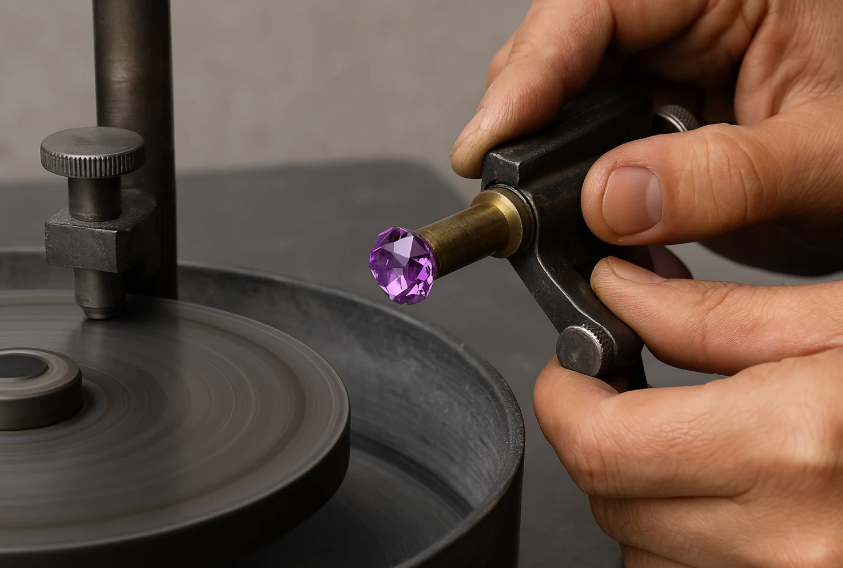
The global market for precision-cut gemstones is undergoing a quiet but significant transformation. As luxury brands compete for tighter tolerances, more complex geometries, and stricter consistency standards, the suppliers who cut stones to specification — rather than to approximate commercial grades — are emerging as critical partners in the manufacturing chain. From Swiss movement houses to Bangkok-based jewelry manufacturers, the conversation has shifted from simply sourcing beautiful stones to sourcing stones that perform.
Precision as a Competitive Differentiator in Gemstone Supply
For much of the twentieth century, gemstone cutting was driven by visual beauty: proportions optimized for brilliance, fire, and scintillation in round brilliants and classic fancy shapes. Today, industrial and luxury applications demand a different framework. Tolerances measured in fractions of a millimeter, angular consistency across batch runs, and uniformity of pavilion depth are now standard requirements for clients operating in regulated manufacturing environments.
This shift has been particularly pronounced in the sapphire sector. Corundum’s hardness (Mohs 9) and optical clarity make it the material of choice for mechanical and decorative components alike. However, the same hardness that makes sapphire desirable also makes it difficult to cut with the consistency high-volume manufacturers need. Suppliers offering precision cut sapphires at scale — with dimensional tolerances held across multi-unit orders — occupy a genuinely specialist position in the supply chain.
The Watch Industry’s Evolving Relationship with Gemstone Components
Watchmaking has long relied on sapphire crystal for dial covers and case backs, but the past decade has seen gemstone integration move deeper into the movement and case architecture. Bezels, pushers, and crown elements set with stones are no longer exclusively the domain of haute joaillerie complications; mid-market and sport-luxury watches are incorporating gemstone accents with increasing frequency.
This trend is partly aesthetic and partly technical. A bezel set with matched stones communicates exclusivity and craftsmanship, but it also must meet the mechanical demands of daily wear. Stones that fail dimensional checks at setting — even by hundredths of a millimeter — create significant downstream losses for case manufacturers. The industry response has been to move specification requirements upstream, demanding gemstones for watch bezels that arrive pre-validated against CAD drawings and setting tolerances before they ever reach a watchmaker’s bench.
This specification-led procurement model requires suppliers who understand manufacturing workflows, not just gem grading. Companies such as VOGEM, a specialist gemstone cutting and supply operation, have positioned themselves at this intersection — offering stones cut to client-supplied technical drawings rather than to general commercial standards.
See also: Revolutionising Medical Diagnostics with Advanced Imaging Technology
Drawing-Based Production: From Concept to Cut Stone
The concept of gemstones manufactured against technical drawings rather than traditional cut grades represents one of the more significant structural shifts in the fine gemstone supply industry. In conventional gem trading, a buyer selects from existing inventory within a grade range. In drawing-based production, the buyer defines the geometry first — shape, table percentage, pavilion angle, girdle thickness, calibrated diameter — and the cutter produces to that specification.
This approach is particularly valuable in product lines where stone and setting are designed simultaneously. Jewelry designers working in CAD can produce gemstones cut to drawing that fit settings with minimal hand-finishing, reducing labor cost and improving batch consistency. For manufacturers running high-volume production lines, the ability to order stones to a fixed technical specification — and receive them within controlled tolerance — fundamentally changes quality control planning.
Market Trends Driving Demand for Bespoke Stone Cutting
Several converging trends are accelerating the adoption of specification-led gemstone procurement across the industry:
- Design differentiation pressure: As global luxury competition intensifies, brands are seeking stones in non-standard shapes and calibrations to distinguish their collections from competitors sourcing the same commercial goods.
- Manufacturing integration: CAD/CAM workflows in jewelry and watch manufacturing have normalized the expectation that all components — including stones — conform to digital specifications.
- Supply chain transparency: Brands and manufacturers are increasingly tracing materials to source, and direct relationships with cutters who work to client specifications support cleaner provenance documentation.
- Reduction of post-delivery waste: Stones that arrive to specification reduce the sorting, re-polishing, and rejection rates that add hidden cost to production.
VOGEM’s operational model reflects an understanding of these dynamics. By focusing on corundum cutting — sapphires and rubies among other varieties — and offering custom calibration services, the company addresses the upstream quality requirements that jewelry and watch manufacturers are increasingly building into their procurement criteria.
Implications for Jewelry Designers and Gemstone Buyers
For independent jewelry designers and smaller manufacturers, the availability of specification-cut stones opens design possibilities that were previously accessible only to high-volume clients. A designer developing a limited-edition collection can now commission stones matched to their exact settings rather than adapting their design to available inventory. This represents a democratization of precision manufacturing capability within the gemstone supply chain.
From a buyer’s perspective, the key evaluation criteria have shifted accordingly. Beyond traditional 4C grading, buyers are now assessing suppliers on dimensional tolerance documentation, batch consistency reporting, and the ability to match technical drawings across production runs. Suppliers who provide this documentation alongside the stones are increasingly preferred over those offering only visual grading certificates.
Conclusion
The direction of the luxury gemstone market is clear: precision, specification, and technical documentation are becoming baseline expectations rather than premium differentiators. As jewelry designers, watch manufacturers, and gemstone businesses adapt to more demanding supply chain requirements, the cutting operations capable of meeting those requirements will define the next generation of the trade. Manufacturers evaluating their gemstone supply partnerships should assess not only stone quality but supplier capability to deliver calibrated, specification-matched materials at scale.
For more information on precision gemstone cutting services and sapphire supply, visit https://www.vogem.com/.