Electricity is the invisible force that powers every aspect of modern business. From the moment you flip the lights on in the morning to the last computer that shuts down at the end of the day, your entire operation depends on a safe, reliable, and properly maintained electrical system. Lighting, heating, cooling, refrigeration, machinery, data networks, security systems, point-of-sale terminals, and communication infrastructure all draw on the electrical supply running through your walls, and when something goes wrong, the impact on your business can be immediate and severe.
Yet electrical systems are one of those things most business owners take for granted until they fail. A tripped circuit breaker that shuts down your server room in the middle of a busy trading day. Flickering lights that make your retail space feel uninviting. An overloaded switchboard that poses a genuine fire risk to your staff and customers. These are not hypothetical scenarios. They happen to Australian businesses every single day, and in almost every case, they could have been prevented with proper professional attention.
This guide explores why professional electrical services are essential for any commercial operation, what kinds of work your business is likely to need, how to choose the right professional, and why building a long-term relationship with a qualified expert is one of the smartest investments you can make as a business owner.
Understanding Why Commercial Electrical Work Differs From Residential
The electrical demands of a commercial property are fundamentally different from those of a typical home. A residence might draw power for lights, appliances, and a few personal devices. A business premises, on the other hand, may need to support high-powered machinery, extensive lighting systems, three-phase power supplies, data cabling infrastructure, commercial-grade air conditioning, industrial ventilation, and security and fire detection systems, often all running simultaneously.
This increased complexity means that commercial electrical work requires a deeper level of expertise, more rigorous compliance with Australian Standards, and a thorough understanding of the specific regulations that apply to different types of business premises. A retail shopfront has different requirements from a commercial kitchen. A warehouse has different needs from a medical practice. And a construction site has different demands from a corporate office tower.
The wiring, switchboard capacity, circuit protection, and cable management in a commercial setting all need to be designed and installed with the specific demands of the business in mind. Undersized wiring can overheat under heavy loads. An inadequate switchboard can trip constantly, disrupting operations and damaging sensitive equipment. Poor cable management can create trip hazards, interfere with data signals, and make future maintenance unnecessarily difficult and expensive.
A qualified professional who specializes in commercial work understands these nuances and can design, install, and maintain electrical systems that are safe, compliant, efficient, and fit for purpose. This is not work that should ever be entrusted to someone without the proper training, experience, and licensing.
See also: Face Liveness Detection: The Technology That Proves You Are Really You
Core Services an Electrician Provides for Business Properties
Switchboard Upgrades and Electrical Fit-Outs
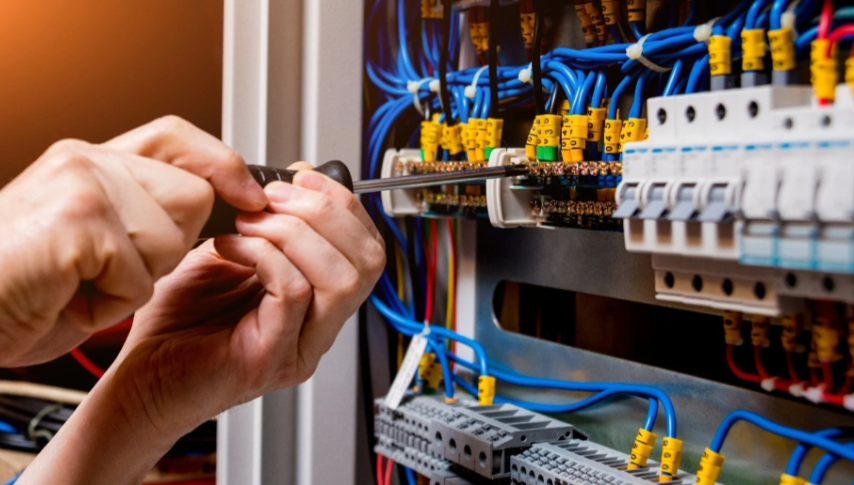
The switchboard is the heart of your building’s electrical system. It distributes power to every circuit in the premises and provides critical safety protection through circuit breakers and safety switches. In older commercial buildings, it is not uncommon to find switchboards that are decades old, fitted with outdated ceramic fuses rather than modern circuit breakers, and struggling to handle the electrical loads of contemporary business equipment.
An outdated switchboard is more than just an inconvenience. It is a serious safety hazard. Old fuses do not provide the same level of protection as modern safety switches, which are designed to cut power within milliseconds if they detect a fault that could cause electrocution or fire. Upgrading your switchboard is one of the most important investments you can make in the safety of your premises, your staff, and your customers.
For businesses moving into a new premises or undertaking a renovation, a complete electrical fit-out ensures that the wiring, lighting, power points, data cabling, and switchboard are all designed to meet the specific needs of your operation from day one. This kind of planned, purpose-built installation is far more efficient and cost-effective than trying to adapt an existing system piecemeal as your needs evolve.
Lighting Design and Installation for Commercial Spaces
Lighting has a profound impact on the way your business looks, feels, and functions. In a retail environment, the right lighting can highlight products, create ambiance, and influence purchasing decisions. In an office, it affects concentration, productivity, and employee wellbeing. In a warehouse or workshop, it is essential for safety and operational efficiency.
Modern commercial lighting has moved well beyond the fluorescent tubes that dominated workplaces for decades. LED technology offers dramatically lower energy consumption, longer lifespan, better colour rendering, and far greater flexibility in terms of design and control. Smart lighting systems can be programmed to adjust automatically based on the time of day, occupancy levels, or available natural light, reducing energy costs while maintaining optimal conditions for your staff and customers.
A qualified professional can assess your space, understand your business requirements, and design a lighting solution that balances aesthetics, functionality, and energy efficiency. They can also ensure that emergency and exit lighting meets the requirements of the Building Code of Australia and relevant Australian Standards, which is a legal obligation for all commercial premises.
Power Point Installation and Circuit Additions
As businesses grow and evolve, their power requirements change. New equipment gets added, workstations are reconfigured, and areas of the premises are repurposed. It is surprisingly common for business owners to rely on power boards and extension leads to bridge the gap between what their electrical system provides and what their operation actually needs. This might seem like a harmless workaround, but it can be genuinely dangerous.
Overloaded power points and daisy-chained extension leads are a leading cause of electrical fires in commercial premises. They can also damage sensitive equipment, cause data loss, and create trip hazards for staff and customers. The proper solution is to have additional power points and dedicated circuits installed by a qualified professional, ensuring that each area of your premises has adequate, safely distributed power to meet its demands.
Safety Compliance and Electrical Testing for Australian Businesses
Australian businesses have a legal obligation to maintain safe electrical systems in their premises. This obligation falls under both workplace health and safety legislation and the specific electrical safety regulations that apply in each state and territory. Failure to comply can result in significant fines, prosecution, and in the worst case, liability for injuries or deaths caused by electrical faults.
Regular testing and tagging of portable electrical equipment is one of the most visible compliance requirements. Under AS/NZS 3760, all portable appliances in a workplace need to be inspected and tested at intervals that depend on the type of premises and the environment in which the equipment is used. A construction site, for example, requires more frequent testing than a standard office environment due to the harsher conditions.
Residual current device (RCD) testing is another critical requirement. RCDs, commonly known as safety switches, are designed to protect people from electric shock by cutting power within milliseconds of detecting a fault. They are required by law in all Australian workplaces, and they need to be tested regularly to ensure they are functioning correctly. A safety switch that fails to trip when it should is worse than useless because it creates a false sense of security.
Thermal imaging inspections are an increasingly popular tool for identifying hidden electrical faults before they cause problems. Using an infrared camera, a qualified professional can detect hot spots in switchboards, wiring, and connections that indicate loose connections, overloaded circuits, or deteriorating insulation. These faults are invisible to the naked eye but can lead to equipment failure or fire if left unaddressed.
The principles of electrical safety have evolved significantly over the past century as our understanding of electricity and its hazards has deepened. For those interested in the science and history behind how we protect people from electrical dangers, the Electrical safety article on Wikipedia provides a thorough overview of the standards, practices, and technologies that underpin modern electrical safety in workplaces and homes alike.
Energy Efficiency Solutions That Save Your Business Money
Energy costs represent a significant and ongoing expense for most Australian businesses. With electricity prices continuing to rise, finding ways to reduce your energy consumption without compromising your operations is not just good for the environment; it is good for your bottom line.
A professional energy audit is one of the most effective starting points. This involves a thorough assessment of your electrical systems, equipment, and usage patterns to identify areas where energy is being wasted and where efficiencies can be gained. The findings often reveal simple, cost-effective changes that can deliver meaningful savings almost immediately.
Upgrading to LED lighting is one of the most impactful energy efficiency measures a business can take. LEDs use up to 80 percent less energy than traditional incandescent or halogen bulbs and last many times longer, reducing both your electricity bills and your maintenance costs. When combined with occupancy sensors and daylight harvesting controls, the savings can be substantial.
Power factor correction is another area where a qualified professional can help your business save money. Many commercial properties, particularly those with inductive loads like motors, compressors, and fluorescent lighting, have a poor power factor that results in higher electricity charges from the energy retailer. Installing power factor correction equipment can bring your power factor closer to unity, reducing your demand charges and improving the overall efficiency of your electrical system.
Solar power systems are an increasingly popular option for Australian businesses looking to take control of their energy costs. A well-designed solar installation can dramatically reduce your reliance on grid electricity during daylight hours, and excess energy can often be exported to the grid for a feed-in tariff. The initial investment is significant, but the long-term savings and the environmental benefits make it a compelling proposition for many businesses.
Data and Communication Cabling for Modern Workplaces
In today’s connected business environment, reliable data and communication cabling is just as important as your power supply. Your network infrastructure supports everything from internet access and email to cloud-based applications, VoIP phone systems, point-of-sale terminals, security cameras, and wireless access points. A poorly designed or installed cabling system can cause slow network speeds, dropped connections, interference, and endless frustration for your staff.
Structured cabling, which follows a standardised approach to designing and installing network infrastructure, provides a reliable, scalable foundation for your business communications. It organises your cabling into a neat, logical system that is easy to manage, troubleshoot, and expand as your business grows. This is in stark contrast to the tangled mess of cables that develops when connections are added ad hoc over time.
A qualified professional can design and install a structured cabling system that meets your current needs and provides capacity for future growth. They will ensure that all cabling meets the relevant Australian Standards, that cable runs are kept away from sources of electrical interference, and that terminations and patch panels are labelled clearly for easy identification and maintenance.
Emergency Electrical Services for Businesses
Electrical emergencies do not wait for convenient times. A power outage on your busiest trading day. A burning smell from the switchboard at midnight. A sparking power point in a customer-facing area. These situations require an immediate, professional response to protect your property, your people, and your business operations.
Having a relationship with a trusted professional who offers emergency callout services means you can get expert help quickly when you need it most. An experienced commercial specialist will know how to diagnose the problem efficiently, isolate the fault safely, and carry out the necessary repairs to get you back up and running with minimal disruption.
It is worth noting that some electrical emergencies require immediate action even before your professional arrives. If you smell burning or see smoke coming from any electrical fitting, switchboard, or appliance, turn off the power at the main switch if it is safe to do so and evacuate the premises. If there is a risk of electric shock or if someone has been injured, call emergency services immediately. Your professional will handle the rest once they arrive.
Investing in preventive maintenance is the best way to reduce the likelihood of electrical emergencies. Regular inspections, testing, and servicing of your electrical systems catch potential problems before they escalate into urgent situations. Think of it as the electrical equivalent of changing the oil in your car. A small, routine investment that prevents far more expensive and disruptive breakdowns.
How to Choose the Right Electrical Professional for Your Business
The quality of your electrical work has a direct impact on the safety, efficiency, and reliability of your business premises. Choosing the right professional is not a decision to take lightly, and there are several key factors that should guide your selection.
Licensing and Qualifications
In Australia, all electrical work must be carried out by a licensed professional. This is a legal requirement, and engaging an unlicensed person to perform electrical work puts your business at serious risk, both in terms of safety and legal liability. Always verify that your prospective provider holds a current electrical licence issued by the relevant state or territory regulator. In Western Australia, for example, this is the Building and Energy division of the Department of Mines, Industry Regulation and Safety.
Beyond the basic licence, look for professionals who hold additional qualifications or specialisations relevant to your needs. This might include endorsements for working on specific types of equipment, certifications in testing and tagging, or training in emerging technologies like solar power and battery storage systems.
Commercial Experience and Industry Knowledge
As we have discussed, commercial electrical work is a different beast from residential work. The systems are more complex, the compliance requirements are stricter, and the consequences of getting things wrong are more serious. Make sure any professional you engage has substantial experience working on commercial properties and can demonstrate familiarity with the types of systems and challenges relevant to your business.
Ask for examples of previous commercial projects, request references from other business clients, and enquire about their understanding of the specific regulations that apply to your industry. A professional who works regularly with commercial clients will be able to discuss these topics confidently and provide evidence of their track record.
Communication, Reliability, and Professionalism
A good electrical professional is not just technically competent. They are also reliable, communicative, and respectful of your business operations. They show up when they say they will, they explain what work is needed and why in plain language, they provide clear and transparent quotes before starting any work, and they minimise disruption to your staff and customers while they are on site.
Look for a provider who takes the time to understand your business and its specific needs, who is proactive about identifying potential issues before they become problems, and who is available when you need them, including for emergency situations outside of standard business hours.
If you are in or around the Armadale area and need a qualified professional for your business premises, visiting this link is a great place to start your search. A locally based expert who understands the needs of businesses in your area can provide responsive, personalised service and the peace of mind that comes with having a trusted professional just around the corner.
Planning Electrical Work Around Your Business Operations
One of the practical challenges of commercial electrical work is scheduling it in a way that minimises disruption to your business. Unlike a homeowner who can simply leave the house while the work is done, a business owner needs to keep operations running, customers flowing, and staff productive, even while significant electrical work is being carried out on the premises.
A skilled commercial professional understands this and will work with you to develop a plan that accommodates your trading hours, peak periods, and operational priorities. This might mean scheduling work outside of business hours, breaking larger projects into manageable stages that can be completed during quieter periods, or setting up temporary power solutions to keep critical systems running while the main supply is being worked on.
Clear communication is essential during this planning process. Make sure your provider understands your business schedule, any non-negotiable requirements such as keeping refrigeration or data systems running, and any upcoming events or deadlines that might affect the timing of the work. A good professional will factor all of this into their planning and keep you informed every step of the way.
Future-Proofing Your Business With Smart Electrical Infrastructure
The way businesses use electricity is changing rapidly, driven by advances in technology, growing environmental awareness, and the increasing availability of smart building management systems. Investing in electrical infrastructure that can adapt to these changes is a smart move that can save you significant time and money down the road.
Smart building systems allow you to monitor and control your lighting, heating, cooling, and power usage from a central platform, often accessible from your phone or computer. These systems can automate energy-saving measures, alert you to unusual usage patterns that might indicate a fault, and provide detailed data that helps you make informed decisions about your energy management.
Electric vehicle charging stations are another consideration for forward-thinking businesses. As the uptake of electric vehicles accelerates across Australia, offering charging facilities at your business premises can be a valuable amenity for staff, customers, and visitors. Planning for this now, even if you are not ready to install chargers immediately, means ensuring your electrical infrastructure has the capacity to support them when the time comes.
Battery storage systems, which store excess solar energy for use during peak demand periods or power outages, are also becoming increasingly viable for commercial applications. These systems can reduce your reliance on grid electricity, lower your energy costs, and provide a valuable backup power source that keeps your business running during outages.
Final Thoughts on Protecting Your Business Through Quality Electrical Work
The electrical system in your commercial premises is the foundation that supports virtually every aspect of your operation. When it works well, you barely notice it. When it fails, everything stops. Investing in quality electrical work, carried out by qualified professionals who understand the specific demands of commercial properties, is one of the most important things you can do to protect your business, your people, and your livelihood.
Do not wait for an emergency to find a professional you can trust. Build that relationship now, invest in preventive maintenance, and address potential issues before they have a chance to disrupt your operations. The cost of proactive care is always a fraction of the cost of reactive repairs, and the peace of mind that comes with knowing your premises are safe, compliant, and efficient is genuinely priceless.
Your business deserves an electrical system that is as reliable, hardworking, and professional as you are. Find the right expert, invest in doing things properly, and you will have a safer, more efficient, and more resilient business for years to come.