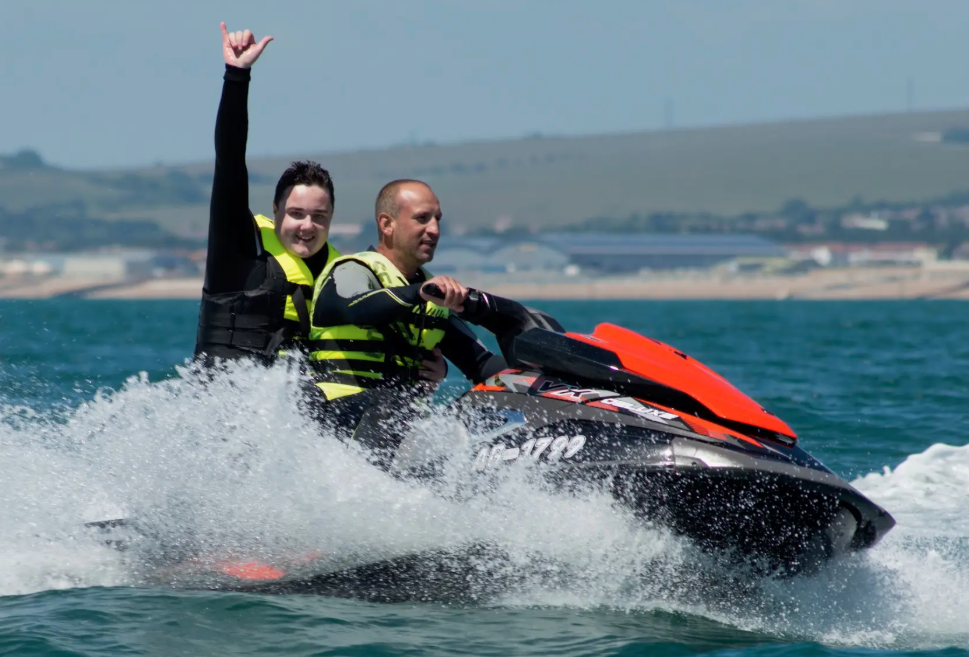
Most people assume you can just turn up, jump on a jet ski, and figure it out. And on a quiet lake in the middle of nowhere, maybe that’s true. But on UK coastal waters — tidal currents, shipping traffic, harbour authority rules, other craft — the gap between thinking you can handle one and actually knowing what you’re doing is wider than it looks from the shore.
That’s not a scare story. It’s the honest reason a jet ski course is worth doing, and it’s also why more and more harbour authorities around the country are starting to require proof of training before they’ll let you launch.
A brief history of the machine itself
“Jet ski” is technically a registered trademark of Kawasaki, in the same way Hoover became shorthand for all vacuum cleaners. The broader category is called a Personal Watercraft, or PWC. The whole thing was invented by one man — Clayton Jacobson II, a Norwegian-American motorcycle enthusiast from Portland, Oregon, who came up with the concept after crashing his dirt bike and wondering, fairly reasonably, whether falling into water might be preferable to tarmac. His first prototype was built by 1965. Kawasaki released the first commercially successful stand-up Jet Ski in 1973, and the sit-down runabout style — the format most people ride today — followed through the 1980s as Sea-Doo and Yamaha entered the market. By the 1990s, PWCs were selling in serious numbers worldwide.
See also: Keep Your Home Efficient: Why Furnace Maintenance Matter
What the RYA PWC Proficiency Course actually involves
The recognised qualification in the UK is the RYA Personal Watercraft Proficiency Certificate — the official standard set by the Royal Yachting Association, which is also the body behind powerboat and sailing training in Britain. It’s a one-day course, open to anyone aged 12 or over, and no previous experience on the water is required.
The day is split between practical sessions on the water and some classroom theory. On the water side, you’ll cover launching and recovering the craft, slow-speed manoeuvring in tight spaces, high-speed handling, emergency stops, and capsize recovery — which is exactly as useful to know as it sounds. The theory covers tidal and weather awareness, basic navigation, collision regulations, and the rules around where you can and can’t ride. That last part matters more than people realise: there are byelaws and designated zones in many UK coastal areas, and ignorance of them doesn’t exempt you from a harbour master’s fine.
Cost sits around £269 per person at most accredited centres, with equipment — wetsuit, helmet, and the craft itself — included. Some centres offer solo training where you have your own jet ski for the full day rather than sharing, which costs slightly less and gives you considerably more water time.
Where to take a jet ski course in the UK
Poole Harbour in Dorset is arguably the best location in England for PWC training. It’s the second largest natural harbour in the world and gives students access to genuinely varied conditions — sheltered water close to the marina for the technical handling sections, with the option of more open coastal water for higher-speed work. New Wave Training, based at Port of Poole Marina, is one of the UK’s busiest PWC training centres and runs the proficiency course alongside the full instructor pathway.
Southampton is another strong option. Ocean Sports Tuition operates from Saxon Wharf Marina on the River Itchen, with direct access to Southampton Water and the wider Solent. Being on tidal, commercially active water means the navigation and rules-of-the-road sections have real-world context rather than being purely theoretical. For those in the north-west, Safe Water Training runs the RYA PWC course out of New Brighton on the River Mersey — an all-year location that provides a different but equally useful training environment.
The ICC question
Once you hold the RYA PWC Proficiency Certificate, you can apply for the International Certificate of Competence — the ICC. This is legally required to operate a jet ski in the Mediterranean and most other European coastal waters. If you’ve ever thought about hiring a jet ski in Croatia, Greece, or Spain and found yourself turned away or faced with a liability waiver the size of a small novel, the ICC is what makes that straightforward.
You can find RYA-accredited jet ski courses across the UK on adventuro, searchable by location and date.

