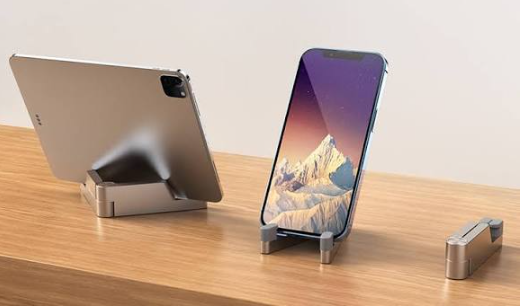
The photograph in a small maker’s catalogue shows a phone standing at a comfortable angle. It does very little to explain where the stand goes when the customer leaves the café. For my proposed product video I would start at the other end of the story. A slim felt pouch lies beside a set of keys. By the time the coffee on the table stops steaming, the viewer should understand what fits in the pouch and why it is there.
A prototype built from two slotted pieces of plywood gives me a simple product to work with. The pieces travel flat, cross at the slots and provide a ledge for a phone. I would measure and photograph an actual prototype for any claims about size or compatibility. The question for the film is narrower. Can a few seconds of movement explain the relationship between the object people see in a catalogue and the thing they can carry?
Start the film with the thing that leaves the shop
The flat package is a better opening than a spinning glamour shot. It gives the viewer a mystery and it offers an honest reference for scale. I would put a real key beside the pouch, then photograph the arrangement from a seated person’s eye level. A yellow stitch on the flap would establish a detail I can bring back in the last frame. The fabric and wood should look like materials somebody could actually touch.
In my notes the first line for Seedance 3.0 would read, “Stay beside the keys while the shadow of the cup moves off the yellow stitch.” That direction makes a video out of a still composition without asking the model to assemble the product. Text specifies the change and a photograph supplies the objects. I want the viewer’s eye to land on the flap just before a real hand reaches in to open it.
For the second shot I would film the maker sliding both pieces out of the pouch. The narrow slots need to look exactly as they do on the physical prototype. There is a commercial reason to be precise here. Someone trying to decide whether an accessory belongs in their bag will look closely at joints and thickness. I would rather show one ordinary, clear take of the real parts than an imagined mechanism that happens to look impressive.
See also: How Lifestyle Coaching Has Become Part Of Cosmetic Dentistry
What motion can tell us about the object
The centre of the film is the point where flat pieces become a three-dimensional support. I would cover that action with an overhead recording, keeping the slots against a dark cloth so their outlines remain visible. A short pause before the pieces meet would give the audience time to anticipate the assembly. I would avoid cutting directly from two loose pieces to a finished stand, since that skips the moment the photograph fails to explain.
The generated material could return after the real assembly. A reference photograph of the finished stand would fix its position on the table. In Seedance 3.0 I could try a change of focus from the empty felt pouch to the wood grain behind it. The phone and stand should remain steady. Seen after the genuine assembly, that quiet shift gives the viewer a moment to connect the final shape with the flat package.
My first review would happen with the edit running on a phone, held at normal reading distance. If the slots disappear I would reshoot the centre section closer. If the yellow stitch steals attention during the assembly, I would move the pouch farther from the action. Neither correction calls for a fresh product design. The aim is to make the existing mechanism readable under everyday viewing conditions.
Choose which parts of the café travel with the camera
An entire café is more detail than this story needs. A table edge, a saucer and a patch of daylight are enough to locate the action. I would record my own short clip of light moving over the table as a possible motion reference. A sound recording of keys being set down could supply a timing cue. Seedance 3.0 can combine text, images, video and audio references when generating video, so those materials can describe different aspects of one moment.
A plausible failure would be a phone that appears to grow as the background goes out of focus. I would compare its edges with the visible edges of the stand in the starting photograph. If their relationship changes, I would reduce the focus shift and frame the front lip more clearly. For this Seedance 3.0 pass, a stable outline matters more than the softness of the café beyond it. A viewer should never have to guess which piece supports the phone.
It might be tempting to add a line claiming that the stand holds every phone or works on any surface. I would leave that out of the film unless the maker had evidence for the statement. A genuine shot of a particular device resting on the particular prototype is informative enough. The shop can give verified measurements in its catalogue, where a customer can take their time comparing them.
Finish the transaction the pictures began
To plan another generated pass I would consult the published Seedance 3.0 pricing for current plans and credit costs. The shot I would protect is the return to the pouch. Seeing the object pack flat again answers the opening question. A decorative third view of the coffee would be a poor trade if it used up the attempts needed to get that last composition right.
At the end I would return to a real tabletop and show the two pieces coming apart. The hand slides them back into the pouch. The keys leave the table with it. That is the whole argument for portability, made without an animated ruler or an unverified weight claim. A short title in the edit can identify the maker and point viewers towards the catalogue for specifications.
I would keep the original footage of the assembly available to the shop as a separate, slower demonstration. The short promotional cut can credit its generated introductory and closing details in the description. If a customer remembers the yellow stitch and can explain how a flat parcel becomes a stand, the little pocket test in Seedance 3.0 has delivered something that the original catalogue photograph could not.