Customers Find the Cracks Before Management Does
A customer rarely knows how many applications a service company uses.
They know the technician arrived 40 minutes later than promised.
They know they already explained the equipment problem to someone on the phone, yet the technician asks them to explain it again.
They know additional work was approved onsite, but the final invoice does not reflect what happened.
Those moments make the one-system debate more practical than it sounds.
Even service contract profitability monitoring eventually depends on the same operational continuity. A contract may look profitable in accounting while repeated visits, extra labor, unrecorded scope changes, and administrative cleanup quietly consume margin elsewhere.
The same disconnect affects customers. If scheduling, field execution, customer records, documentation, and billing rely on different versions of the job, somebody has to reconcile them.
That somebody is often an employee.
Sometimes it becomes the customer.
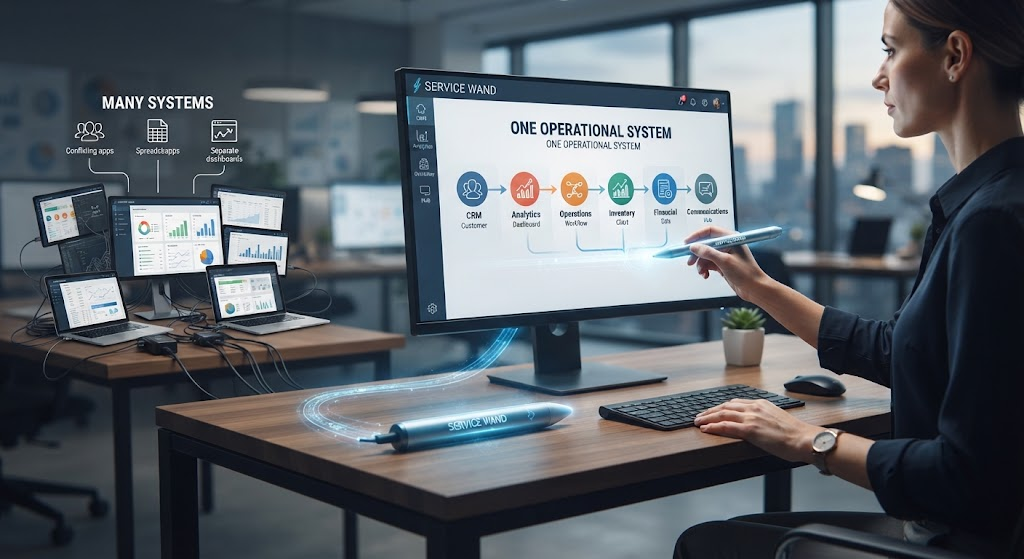
The argument for one operational system begins there: not with fewer software subscriptions, but with fewer contradictory versions of the service experience.
What “One System” Should Actually Mean
A unified operating model does not necessarily mean every employee uses one screen or that every specialized application disappears.
The useful distinction is whether the core operation shares the same context.
Shared Data Is Only the Beginning
A customer address can technically exist in several integrated applications.
That does not guarantee those systems understand the same service event.
The more important question is whether a change travels with its meaning.
If a customer reschedules, does dispatch see the new commitment? Does the technician receive the updated arrival window? Does routing adjust? Does customer communication reflect the same change?
A system can synchronize data while still fragmenting the workflow.
See also: Emerging Market Trade Shows: An Underrated Growth Channel for Tech Firms
Shared Logic Matters Too
Consider an approved scope change.
The customer agrees to additional work onsite. The technician records it. Billing needs to know what was approved, what was performed, and what should be charged.
This is where software that connects the front office and field becomes more valuable than a simple integration between two databases.
The operational rule has to survive the handoff, not merely the text entered into a field.
That distinction sits at the center of Service Wand’s model: customers, services, assets, workflows, billing, and operational logic operate on a shared foundation rather than as isolated modules.
The Customer Experience Is an Operations Report in Disguise
Most companies measure customer experience separately from operations.
In reality, customers are constantly reporting on operations without realizing it.
An accurate arrival window says scheduling, routing, technician status, and communication stayed aligned.
A technician who already understands the property history says customer records survived the handoff to the field.
A clear completion report says field documentation remained attached to the correct job.
An invoice that matches the work performed says operational reality reached finance intact.
The reverse is just as revealing.
“Why didn’t anyone tell me the appointment changed?”
“Didn’t your last technician write this down?”
“Why am I being charged for something different from the quote?”
These sound like customer-service complaints. Often they are systems problems.
That is why the one-system thesis should not be judged by whether the architecture looks elegant on a diagram.
Judge it by how rarely the customer has to repair the company’s internal communication.
The Strongest Arguments Against One Operational System
The unified-platform argument has legitimate weaknesses, and buyers should take them seriously.
Specialized Tools Can Be Better
A dedicated routing product may outperform a broader platform for unusually complex routing. A specialized accounting system may have financial capabilities an operational product should not attempt to replace. Industry-specific diagnostics or compliance tools may also deserve their own place.
Trying to force every specialist function into one application can create mediocrity.
There is also vendor concentration risk. A business that depends deeply on one operational provider needs confidence in reliability, portability, security, support, and long-term adaptability.
Those objections are real.
Consolidation Can Become Rigidity
The second concern is process fit.
Some “all-in-one” products achieve simplicity by forcing customers into fixed workflows. The company gets fewer applications but loses the ability to operate the way its business actually works.
That is not operational progress.
A credible unified model therefore needs flexibility. Service Wand positions itself around configurable data structures, workflows, roles, billing logic, automation, and integrations rather than requiring every organization to use identical processes.
A field service operations platform should also be able to coexist with genuinely valuable specialist systems.
The goal is not software purity.
It is operational coherence.
Fewer Boundaries Matter More Than Fewer Vendors
This leads to a more useful way to evaluate the one-system argument.
Do not begin by counting applications.
Count operational contradictions.
Take a recent job and ask what each part of the company believed at the same moment.
- What appointment time did the customer have?
- What time did dispatch have?
- What address did routing use?
- What scope did the technician receive?
- What work did the completion record show?
- What amount did billing expect?
If every answer agrees, the technology architecture is doing its job—even if several products are involved.
If the answers routinely diverge, adding another integration may not solve the underlying problem.
This is why a unified operational core can matter more than a technically connected stack. It reduces the number of places where business logic must be recreated and maintained.
That becomes even more important as automation and AI are introduced. Automated decisions inherit whatever contradictions already exist underneath them.
Faster inconsistency is still inconsistency.
How to Decide Whether Consolidation Is Worth It
Start with customer outcomes rather than a software inventory.
Choose several recent jobs, including one that went smoothly and one that became difficult.
Trace each from initial request through scheduling, dispatch, field work, documentation, invoice, and payment.
Look for moments when employees had to confirm which system was correct.
Look for data that had to be copied.
Look for customer questions that required someone to call another department.
Look for work completed in the field that billing could not immediately understand.
Then separate necessary specialization from accidental fragmentation.
A specialist application that provides unique value may deserve to stay.
A second system that merely stores another version of information already held elsewhere probably deserves more scrutiny.
That produces a more balanced conclusion than “one platform is always better.”
The strongest operating model is the one that preserves the same customer and job context from promise through payment with the least manual translation.
Sometimes that can be achieved through carefully integrated systems.
Sometimes the growing burden of keeping those systems aligned makes a unified operational core more practical.
The customer does not care which architecture wins.
They care that the technician arrives when expected, already understands the job, documents the work properly, and leaves behind an invoice that makes sense.
That may be the best argument for one operational system of all.