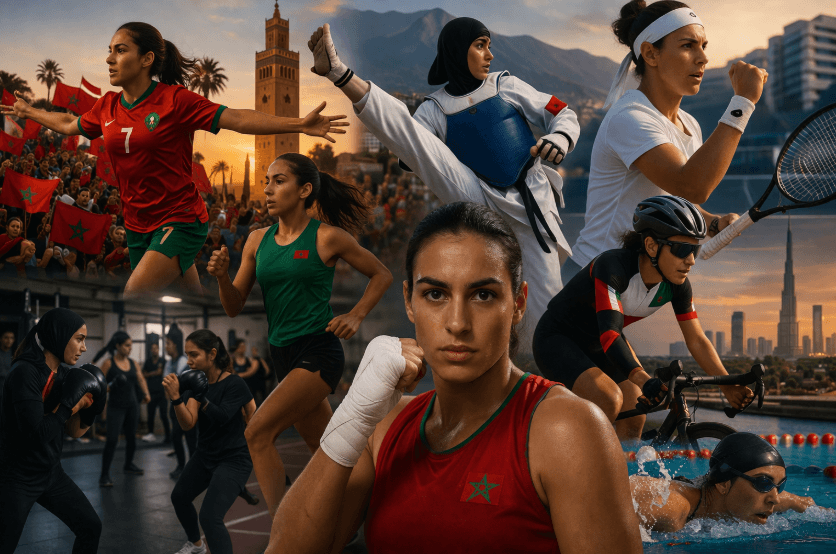
Women in MENA sport are no longer fighting just for visibility. They are getting results. Morocco’s run to the 2022 Women’s Africa Cup of Nations final and qualification for the 2023 FIFA Women’s World Cup changed the conversation. The same is happening across the region.
Morocco already has strong names. Khadija El Mardi won world boxing gold in 2023. Rababe Arafi has reached major 1500m finals. Oumaima El Bouchti is competing internationally in taekwondo. Sara El Bekri has represented Morocco in Olympic swimming.
The pattern goes beyond Morocco. Tunisia’s Ons Jabeur reached two Grand Slam finals in 2022. Saudi Arabia’s Dunya Abutaleb is rising in taekwondo. The UAE’s Safiya Al Sayegh is building her profile in cycling. These are not isolated examples anymore.
The way people follow these athletes has changed too. It is no longer only about big tournaments. Fans now track results, form, and schedules year-round. For Moroccan audiences, platforms analysing regional sports data, where 1mlnbet.com/ar/ gives visibility into results and competition activity over time, make that follow-up easier.
What’s changing in practice
The shift is visible at ground level before it appears in policy.
- More women are entering structured training in boxing, athletics, and football.
- Growing demand for coaching in urban fitness spaces.
- Local competitions attract repeat participation and spectators.
- Brands are starting to invest in individual female athletes.
In Casablanca and Rabat, gym owners report steady growth in female participation, particularly in combat sports. Five years ago, women in boxing classes were rare. Now they are expected.
The infrastructure gap
Performance is accelerating faster than systems.
Elite athletes are competing globally, but development pathways remain inconsistent. Access to coaching, facilities, and funding still depends heavily on geography and local support.
Morocco’s football federation has invested in women’s programmes, but other disciplines rely more on independent clubs. That creates uneven progression between junior and elite levels.
Why this moment is different
Consistency changes perception. Ons Jabeur didn’t just reach one final. She repeated it. Khadija El Mardi didn’t just compete, she dominated her division. When results become repeatable, they stop being treated as exceptions. That’s where the real shift happens.
What comes next
The next phase is scale, not visibility. If current performance is matched with structured investment in youth development and coaching, Morocco and the wider MENA region will move from producing standout athletes to building depth across disciplines.
And once depth appears, the system doesn’t revert. It stabilises at a higher level.